





lead forensics image
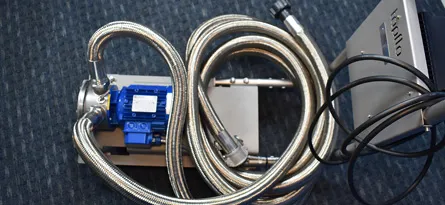
A photo of a SP-LR Self-Priming Liquid Ring Pump on a trolley

SP-LR Self-Priming Liquid Ring Pump Troubleshooting

Edward Shaw
written by:

Technical Manager

Edward Shaw, Technical Manager at Tapflo Pumps UK, began his journey in the Pump Industry straight out of University, quickly advancing through various roles. Beginning as a Technical Sales Engineer, Edward progressed to Senior Applications Engineer and ultimately to Business Development Manager. His extensive experience spans the Oil & Gas, Marine, Industrial, and Food & Beverage pump markets. Edward's expertise lies in technical solutions and developing bespoke pump systems tailored to customer requirements. His in-depth knowledge and innovative approach enable him to create customised solutions that enhance efficiency and reliability. Edward's commitment to excellence and his ability to address complex technical challenges make him an invaluable resource for both our customers and team.

More articles by Edward Shaw
27/02/2020

Having trouble with your Self-Priming Liquid Ring Pump? Our comprehensive guide will help you get up and running in no time.

SP-LR Pump

Pomac Pumps’ SP-LR Pump is a Self-Priming Liquid Ring Pump that has been designed to meet EHEDG specifications for use in food-grade and other hygienic applications.

Malfunctions

What are the main malfunctions and problems with the SP-LR Sanitary Self-Priming Liquid Ring Pump? 

A malfunction in a pump system may be caused by various reasons and is not necessarily the pump itself. Issues with the pipework or other fluid accessories within the system can be contributing factors. Furthermore, if the operating conditions differ too greatly from the provided specification for which the pump was selected for can also be a major contributing factor.

Consequently, it is always recommended to check the following first:

  • Has the pump been installed correctly?
  • Are the operating conditions still according to the initial specification?
  • Are the other fluid accessories within the pipework functioning correctly?

In general, the following malfunctions can be identified:

  1. Pump provides little or no flow
  2. Pump does not reach duty point
  3. Pump provides irregular flow
  4. Pump leaks
  5. Pump vibrates excessively
  6. Pump makes too much noise
  7. Motor overheats
  8. Motor cuts out on thermal overload
  9. Pump has seized

Below is a table of the possible causes and solutions of these malfunctions.

Malfunction Cause Action
1 2 3 4 5 6 7 8 9
  X       X X     electrical connection defective Have qualified electrician check the electric connections
  X               wrong rotation direction Have qualified electrician reverse the sense of rotation of the electric motor
X X X     X       insufficient pre-pressure Increase the pre-pressure or place the pump on a lower position
  X           X   pump operating at the wrong speed Check the motor speed
                X contaminations or objects in the pump Clean the pump, if necessary disassemble
X X X             air in the piping Inspect the piping
  X               valve in suction pipe is not completely open Entirely open the valve in the suction pipe
  X               pump selected with too small delivery head Install another pump
X X X           X suction pipe or filter blocked Clean the suction pipe or the filter
      X           shaft seal defective Disassemble the pump and replace the shaft seal
      X           O-ring seal defective Disassemble the pump and replace the O-ring seal
              X   liquid temperature is too high Decrease the liquid temperature
X             X X impeller is jammed Disassemble the pump and replace the impeller
        X X   X X impeller is damaged Disassemble the pump and replace the impeller
        X X X X X motor shaft is bent Replace the motor
        X X X X X extension shaft is loose Disassemble the pump, inspect the extension shaft, reassemble it and readjust.
        X X X X X bearings are damaged or worn Replace the motor. For IG(F): replace the bearings
              X X motor is overloaded Check the viscosity of the liquid.
Switch off the motor and check if the pump does not drag. If so, disassemble the pump and repair it

Inspection & Maintenance Schedule

Routine inspection and maintenance can avoid unnecessary and expensive downtime as well as operating costs. It is recommended to check the following on a daily basis:

  • That the valve in the suction pipe is completely open
  • That the inlet pressure is not too low in order to avoid the occurrence of cavitation
  • The delivery pressure is in line with system requirements
  • That the shaft seals are not leaking.
  • Pressure and Flow of the flushing system, if present
  • The temperature of the heating/cooling system, if present

For IG & IGH Variants periodically check the bearing oil levels. The oil must be changed annually or after every 5000 operating hours.

Products Mentioned